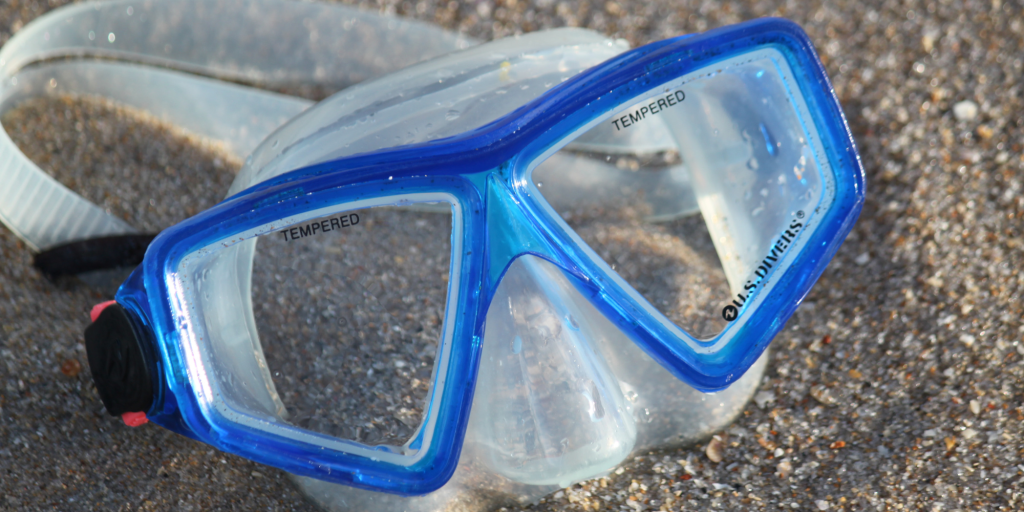
Normal goggles are always a better choice for younger children learning to swim
Firstly I need to clarify that this article is not about children who are learning to snorkel.
As a qualified pool snorkelling instructor (as well as swim teacher), I believe that learning to use the correct equipment and skills to snorkel properly is a super important thing for children to learn. Children aged 8+ who can swim 50m front and back, plus tread water for at least a minute, are ready to learn this exciting skill that could open up all kinds of brilliant future ocean adventures.
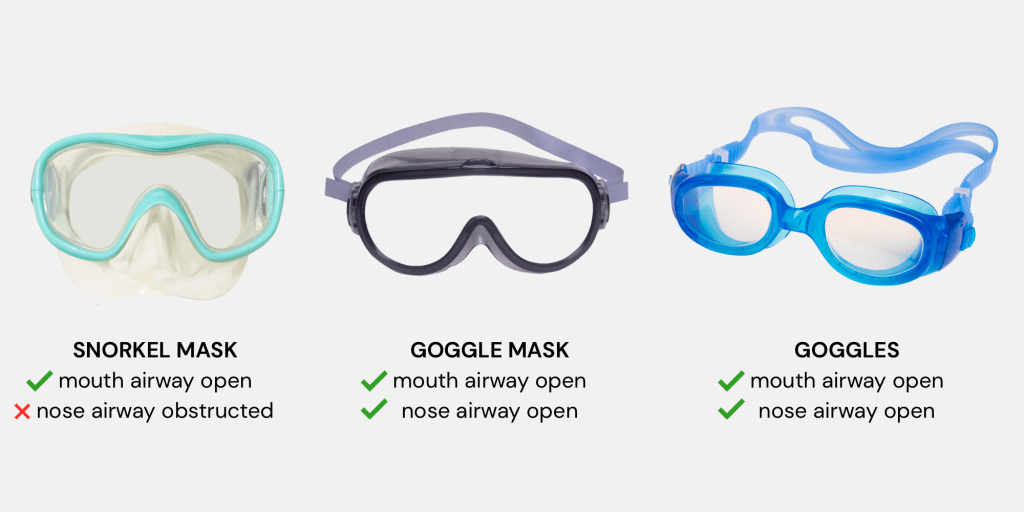
But when teaching stroke development in a swimming pool, that is, a younger child swimming on their front and/or back for 30 minutes as part of a lesson, they shouldn’t wear a snorkel mask or anything that obstructs airflow in and out of their nose (like a nose clip).
‘No snorkel masks permitted’
There are reasons as to why swimming pools often have a ‘no snorkel masks’ rule for recreational swimming:
- Traditional masks can often be made of glass which poses a hazard if it shatters
- Their more clunky design and size can obstruct peripheral vision meaning the swimmer cannot see obstacles or lifeguard announcements as easily
- In general, snorkel masks are designed for open water swimming, not pool swimming
But for me, the single biggest reason as to why I wouldn’t let a young swimmer use a snorkel mask in a pool lesson is because these masks obscure airflow in and out of the nose.
Why breath control is important
I am really big on breath control. I spend more time on it In lessons than most swim teachers I know. I want children (and adults) to have mastered it before they progress in their swim strokes.
Swimming is an aerobic exercise – it increases your heart-rate, your breathing rhythm and just like any other sport, you need a good flow of oxygen to fuel your body. When swimming, we take a good breath in when our heads are up out of the water, then when our face goes into the water, we breathe out calmly, releasing our air, making lots of bubbles. As soon as we raise our head again, we are ready to breathe in.
We need this proper breath control so that:
- We don’t accidentally inhale water
- We aren’t holding our breath (do you hold your breath in any other exercise?!)
- We are exercising calmly, efficiently and with good stamina
You will notice that children who don’t have a steady ‘breathe in, breathe out’ rhythm will get tired and out of breath sooner and their swim strokes won’t progress. Their leg kick, alignment and body position will also be effected as they will be spending twice as long with their heads out (doing an exhale and inhale when it should just be an inhale).
So, what?
I’ve told you all of this technical breathing stuff because now you can imagine how it might be more difficult to focus on all of that if you can’t use both airways available to you.
You know that feeling where you’ve had a cold, your nose is completely blocked and you have to do something strenuous like walk powerfully, and you feel like you can’t quite catch your breath? This is what children are experiencing if we are asking them to swim powerfully and consistently without both airways in use.
Younger children wearing snorkel masks, who have had less years of experience of breath control in water, can often experience confusion when they suddenly cannot use their nose to breathe. These little moments of panic could cause a sudden swallowing of water through the mouth, coughing and general lack of good breath control.
Cheaper snorkel masks can also often fill with water (this is something a child would learn in a snorkelling class – how to efficiently empty a masks, often whilst treading water) and if the nose section fills with water and a younger swimmer doesn’t realise, there is a risk of water inhalation through the nose too.
Also, if children can access their nose free from a mask obstruction, they can more easily learn the Valsalva Manoeuvre (‘popping’ their ears, like on an airplane) to equalise ear pressure when jumping and diving in deeper pools.
Using masks in snorkelling
Why doesn’t all of this matter for snorkelling, then? Snorkelers need to obstruct the nose for various different reasons including equalising the pressure of their mask. You’ll have to learn more about the science of snorkelling if you are interested.
Learning these snorkelling basics is often intended for older children (STA guidelines 8+) who have had more experience developing their breath control in water and had the correct instruction from a professional on how to use a snorkel mask, clean it, clear water and so on. They are better prepared to learn to breathe properly in a way that just uses their mouth.
‘My child doesn’t like water near their nose’
One of the reasons we often see toddlers or young children in snorkel masks in swimming lessons is because the child has told the parent that they don’t like water in their nose and this is holding them back from developing their swimming skills.
If this is your child:
- Trade your snorkel masks for a general kids swimming mask that just covers the eyes (Zoggs make a good first pair)
- Allow your child to practise bubble breathing – this doesn’t have to be in a pool and can be in the bath, in a bowl of water, in a big cup, anything!
- Practise bubbles out the mouth
- Practice bubbles out the nose (make it fun, call it dragon breaths or dragon sneezes!)
- Practise both together
- Over time, with lots of practising, they will instinctively blow bubbles in the way that feels natural to them, utilising both airways
- Other ways to encourage an exhale in water in a fun way, use phrases like ‘blow the candle out’, ‘hum a song’, ‘roar like a lion’, ‘say ooooooh’, and so on
- Other water confidence activities will speed up progress too – let them shower their head, jump underwater, wash their nose with a wet flannel, have a water fight, anything that encourages water on the face (don’t stress, be silly, make it light-hearted)
Keep going
It is more important that the child learns to be OK with water around their nose, than we jump to using something like a snorkel mask or nose clip too early.
Especially with younger children, you have plenty of time for them to find their confidence with this – it is very normal that some children take time and need to find their comfort at their own pace.
Ditch the nose obstructions, keep going, don’t worry and make it fun!
 REBECCA GIVENS